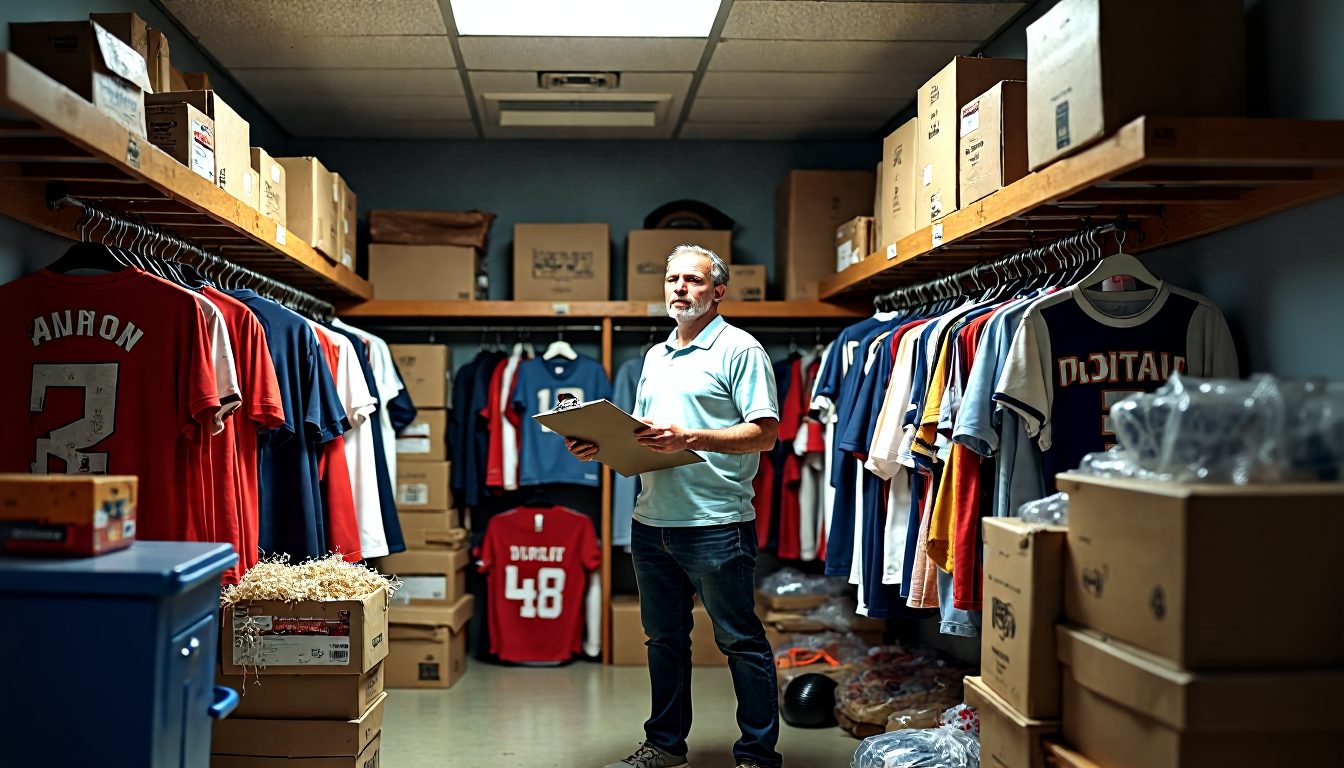
Ask any long-serving club secretary where the spare playing jerseys are and watch what happens. A pause. A look of mild panic. Then: "I think Dave had them last season." Dave left the club eighteen months ago.
Equipment disappears from community clubs constantly — not through theft, but through the slow accumulation of informal loans, undocumented handovers and the quiet assumption that someone else is keeping track. Here's how to stop it.
Why clubs lose equipment
The root cause is almost always the same: equipment is issued informally and returned (or not returned) informally, with nothing written down. The club relies on whoever issued the gear to remember who has it. That person leaves, or forgets, and the gear is effectively lost.
This costs clubs real money. A set of playing uniforms, a PA system, musical instruments, camping gear — these aren't cheap to replace. And insurance claims are hard to make when you can't demonstrate what you owned in the first place.
Step 1 — Build your asset register
The foundation of any equipment tracking system is an asset register — a complete list of everything your club owns. For every item, record:
- Name and description — specific enough to identify it (e.g. "Snare Drum — Pearl Export, black" not just "drum")
- Serial number or identifying mark — if it has one
- Purchase date and cost — for insurance purposes
- Current condition — good, fair, poor
- Category — uniforms, instruments, audio equipment, furniture etc
This doesn't need to be fancy — a spreadsheet will do to start. The important thing is that it exists and that someone owns it.
Step 2 — Record every loan
When equipment leaves the club's possession — even temporarily — record:
- Who took it (name and contact)
- What they took (specific items)
- When they took it
- When it's due back (or whether they're holding it indefinitely)
The indefinite loan problem: Many clubs have members holding equipment permanently — uniforms, instruments, specialist gear — with no formal agreement. These should be documented as indefinite loans, not ignored. If the member leaves, you need a record to prompt the return conversation.
Step 3 — Do a stocktake at least once a year
At least once a year — ideally at the start or end of a season — run a stocktake. Compare your asset register against what's physically in the clubroom, plus what members are documented as holding. Anything unaccounted for gets followed up immediately while memories are fresh.
A stocktake also lets you update condition ratings, flag items needing maintenance, and identify things that are so old or damaged they should be written off and replaced.
Step 4 — Have a return process
The hardest equipment to recover is gear held by members who've left the club. The best time to get it back is when they leave — but only if you have a process for it. When a member resigns or doesn't renew:
- Check the loans register — do they have anything?
- Contact them before their access lapses
- Arrange a handover date
If you don't have a record of what they had, you can't ask for it back.
What about uniforms specifically?
Uniforms need special consideration because members often feel they own them after wearing them for a season. A clear policy helps:
- Are uniforms club property on loan, or purchased by the member?
- If on loan, what's the return condition expected?
- Is there a bond or fee for unreturned items?
Document the policy and make sure every new member understands it when gear is issued.
Track everything in one place
GroupDesk Inventory gives you a proper asset register, loan tracking by member, indefinite loan marking and a PDF stocktake report — without the spreadsheet.
See the Inventory Module →